Bouchra Baibanou’s daring knows no upper limit. She is the only North African to have conquered Mount Everest, the only Moroccan to have climbed to the highest peak of each of the seven continents. Adventuring to the most perilous places on earth, the 53-year-old has endured weeks away from her family to camp on vertiginous shelves of ice, a hair’s breadth away from death by avalanche. And still she ascends. After 30 years at the top, Bouchra can’t stop, won’t stop.
Annapurna is the 10th highest mountain in the world. Located in the Nepalese Himalayas, it is what they call an “eight-thousander”, which is to say its peak, first reached in 1950 by the French mountaineer Maurice Herzog, is more than 8,000 metres above sea level. That is very high, but Annapurna’s reputation is less about altitude than it is about deadliness. It is dangerous, in a way that skill and experience can’t defend against particularly well. A snowstorm, an avalanche, a collapsing ice shelf: Annapurna’s conditions have killed one in five of the 437 people who have attempted to climb it. If that seems like a lot, it’s worth reflecting that until recently, the ratio was one in three.
For the first time ever, earlier this year, Annapurna was conquered by an Arab woman. For the first time ever, it was climbed by a Moroccan citizen, and her name is Bouchra Baibanou. By taxi, the apartment where she lives with her husband, Lahoucine Ouboumalk, known as Houcine, and their 17-year old daughter, Hiba, is about 45 minutes from Rabat’s medina. En route, I am driven along a seafront peppered with basketball and football facilities; then we take a left away from the water and head down the lengthy, busy road into the city of Temara, the Moroccan capital’s de facto southerly suburb.
Bouchra’s expedition to Annapurna this spring was the latest in a series of achievements that have made her into something of a rarity here in Morocco: a star climber, an adventuring celebrity, famous for being both the first Moroccan and first North African to climb Mount Everest, and the first Moroccan to scale the tallest peaks on each of the seven continents, completing the feat known as the Seven Summits challenge. So it was time for yet another statement from the king of Morocco, who had already decorated her, as far back as 2015, as an officer of Wissam al-Mukafaa al-Wataniya (the Order of National Recompense) – a national honour given for deeds of outstanding merit. It is easy to spot when we are at the correct address, as tied to the gates of the leafy apartment complex – opposite a booth in which a security guard assesses us while petting a small cat – is a banner displaying two large images of Bouchra. One is businesslike: Bouchra in motivational speaker mode, smartly dressed in a red blazer and patterned hijab. The other, which I recognise from social media, was taken at the summit of Annapurna: Bouchra brandishing a Moroccan flag and a copy of the Koran. She is wearing a yellow down suit emblazoned with the names of sponsors such as Dari, a couscous brand. It is hard to tell where the snow ends and the cloud in which she is standing begins.
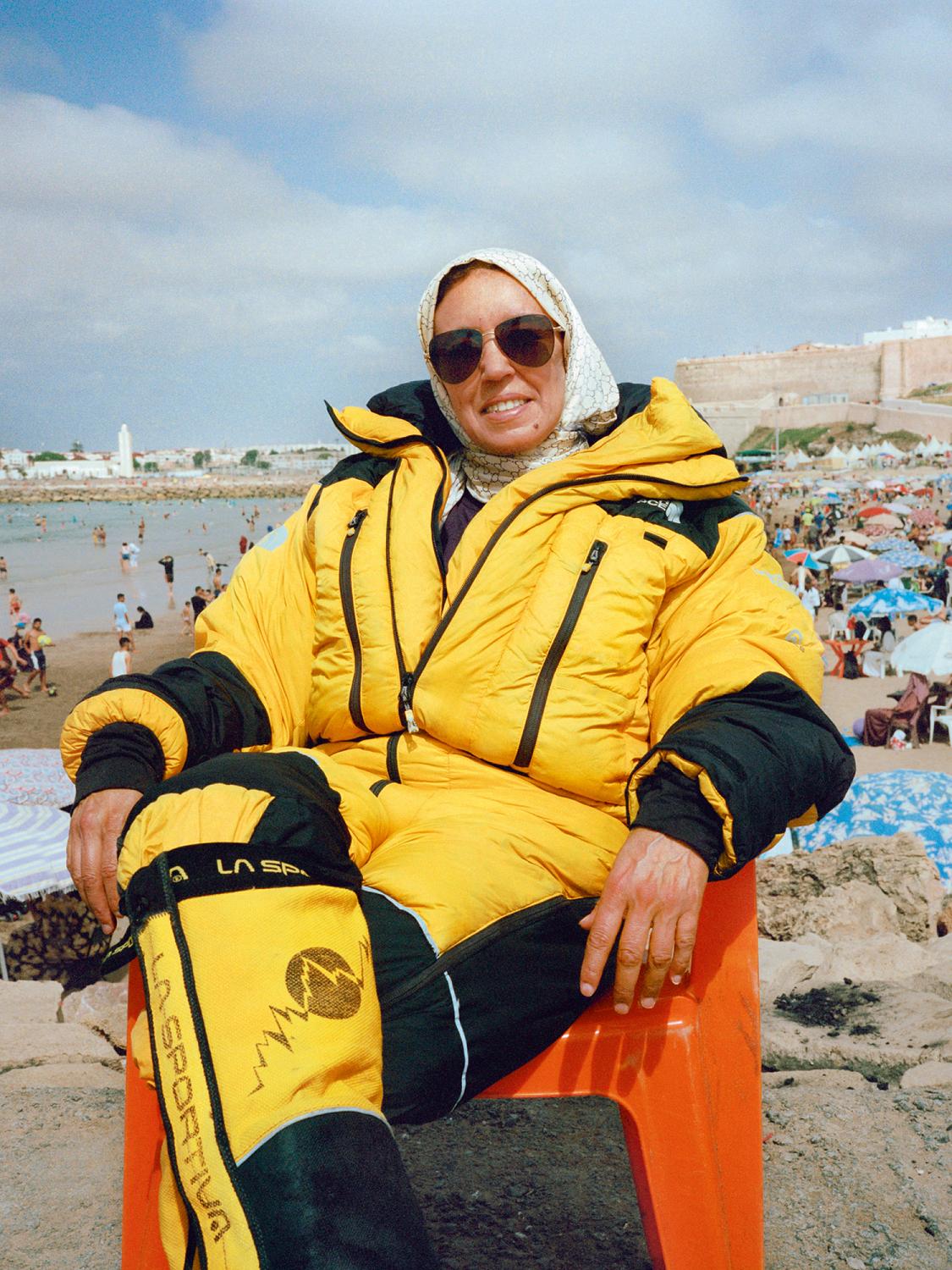
Bouchra was photographed in and around her hometown of Rabat (highest point: 160 metres above sea level). Its jolly beach is close to the medina, a 45-minute drive from where Bouchra lives with her husband, Houcine, and their daughter, Hiba.
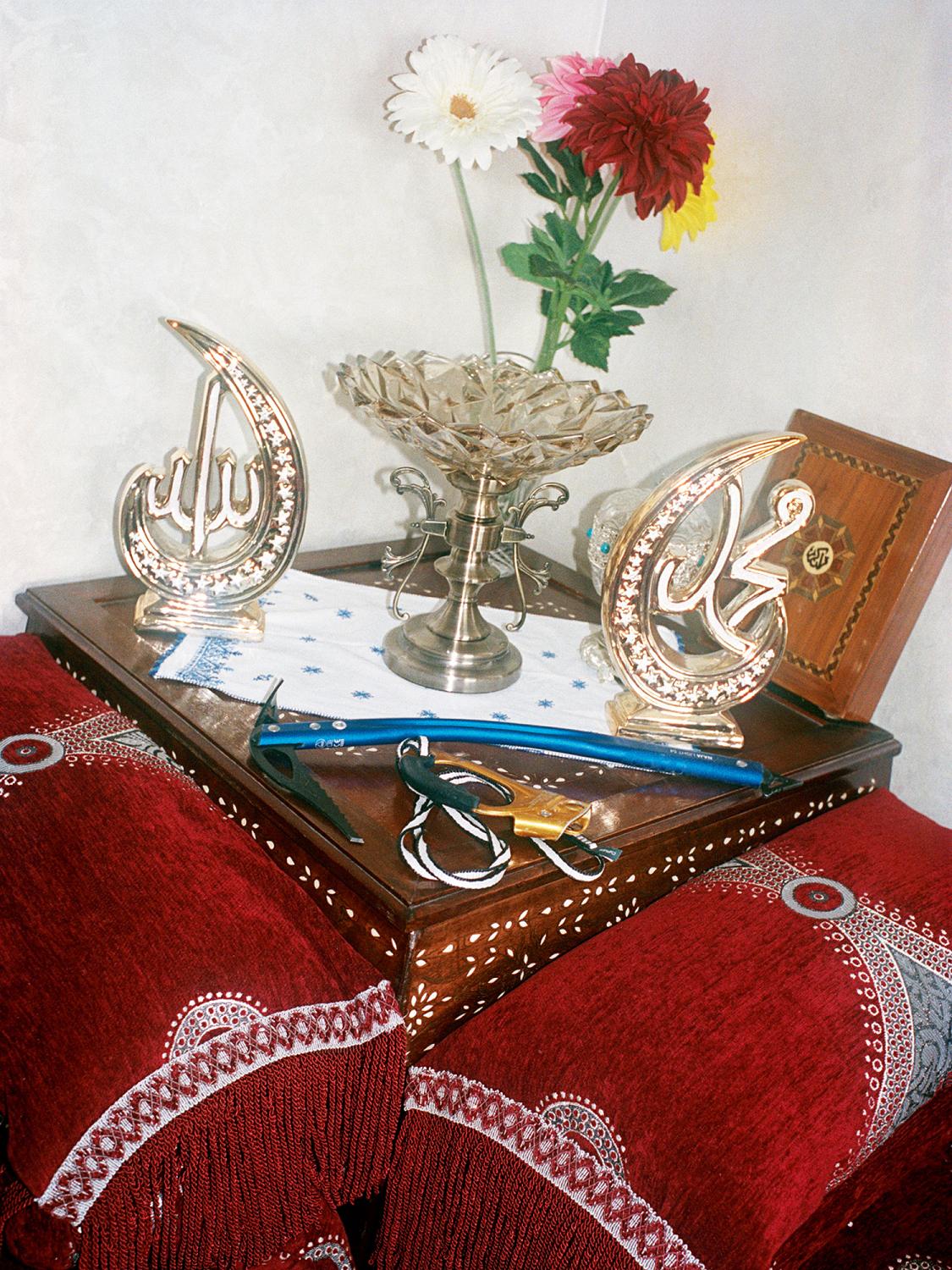
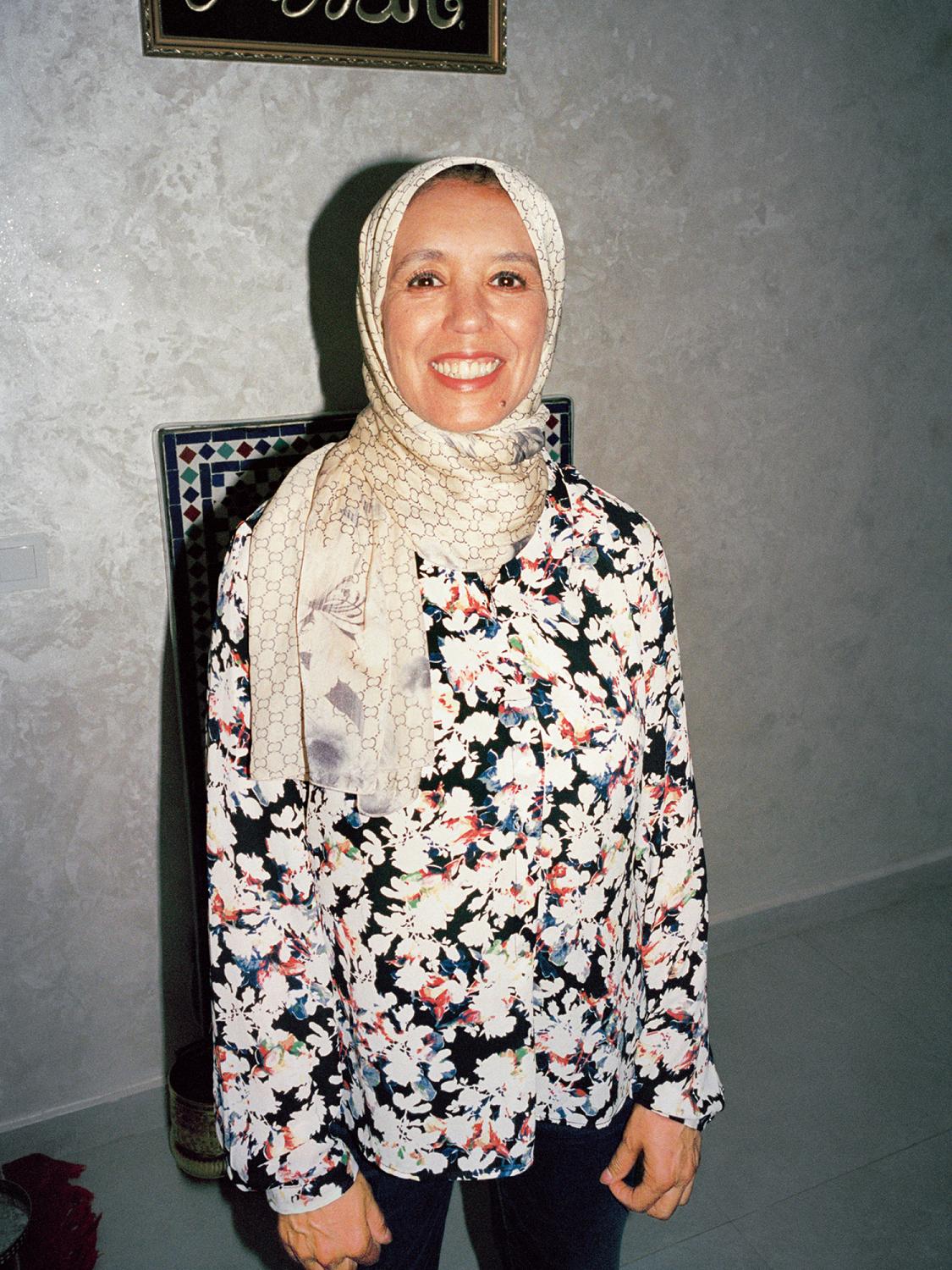
I ring the bell and the door swings open to reveal a warm, welcoming woman in a floral headscarf. We exchange bonjours, and I remove my trainers and follow her into the apartment. She gestures for me to sit on a sofa. On a low cabinet in front of us are ornaments, flowers and framed family photos, the cosy emblems of domestic life. In a giant display case behind my head are innumerable trophies, medals and certificates, testimonies to her intrepid athleticism. It is 10am. Earlier, she had been swimming. Her training regime is relatively light at the moment, given that she returned from Annapurna only six weeks ago.
As a trip nears, she will up the schedule, eventually pushing her physical capacity to three or four hours a day of lifting weights, running and climbing peaks in the local section of the Atlas Mountains. Before her mission to the Alaskan mountain Denali in 2014, knowing she would have to drag a sled across the ice, she would wrap a rope through a giant tyre and haul it up the beach.
Somewhat incredibly, during the period in which she undertook many of her most difficult expeditions, Bouchra also had a day job as a software engineer at the Ministry of Equipment and Transport. Anyone who passes a driving test in Morocco will encounter her legacy, as it was she who spearheaded the country’s move to a screen-based theory test. Since 2020, she has been self-employed, which in Bouchra’s case means she is in the business, essentially, of being herself. She climbs mountains. She shows others how to trek and climb, and she’s a member of the Royal Moroccan Federation for Skiing and Mountain Sports. She works with children to help them find their passion in life, she gives speeches, and coaches adults, women and men, to suggest how they might meet their goals – all with the same unstoppable mindset she deploys in her commutes to the roofs of the world.
When I mention the banner out front, she smiles and says it was a gesture from her family, a way of welcoming her back from Annapurna. “My family was very, very worried about me. I didn’t have any connection for almost three weeks.” For many climbers, Annapurna is the most difficult mountain they will ever climb, with “a different kind of ice”, overhanging seracs and some technical sections that have 70° ramps. It is, Bouchra says, the hardest climb she has done. “It is a very difficult mountain, very steep and very hard to climb. The weather was difficult and there is a high risk of avalanche.”
Listening to Bouchra’s stories from the six-week trip, it is easy to understand her family’s concern. At one point, her party had no choice but to camp in a very dangerous location just above Camp 3. “Not earth. It was just ice, and all night we felt the ice move.” She shows me a photo on her phone. A tent on a white ledge, precarious, on some level almost comically so, like something from a cartoon depiction of a mountaineering expedition, but then chilling for being real. There were four of them sharing the tent. “We were all afraid. The place was so small. It could have fallen at any time.”
They navigated a passage known for the possibility of sudden avalanches. “If you cross and the avalanche comes, you die,” she tells me. An avalanche did come, but just before they were about to set out. “I was just a little bit in the rock, not far from the passage, when I heard it coming. I stuck to the rock and stayed there.” At that moment, the difference between being alive or otherwise was an arbitrary matter of seconds. Now she’s here in her living room, offering me coffee. “After that, I crossed it,” she says.
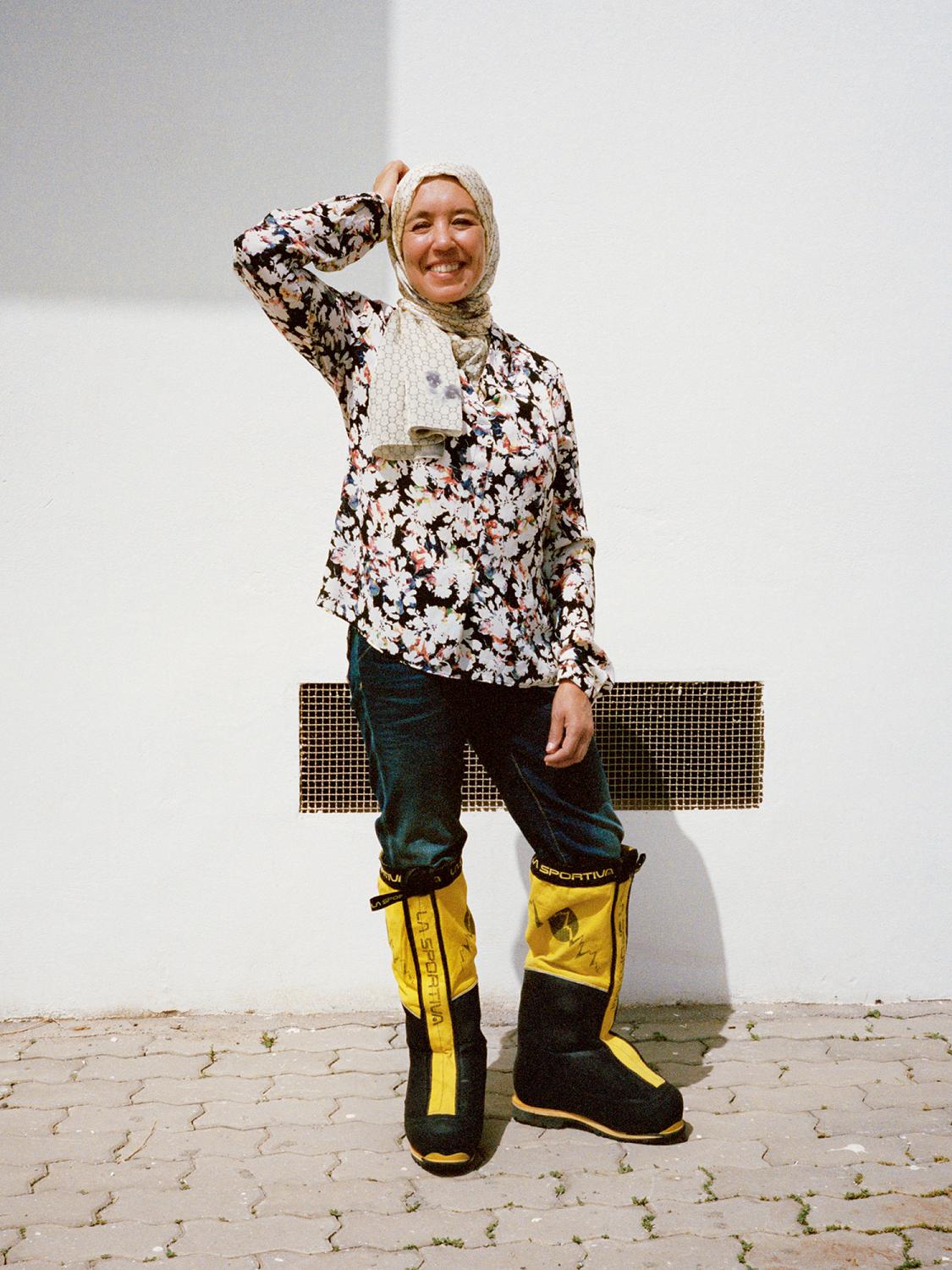
“The mountains belong to nobody; going there teaches us to have an open mind.”
Located about 80 far-from-straightforward kilometres south of Marrakesh, Toubkal, at 4,167 metres, is the tallest peak in the Atlas Mountains, which is to say whoever stands on it is higher up than all 37 million of the other people who are in Morocco at any given time. Bouchra was 25 when, drawn by that prospect, she gave getting there a try, inviting a friend from school to join her. “I didn’t know anything about climbing,” she says. “It was the first time I’d been to a place like that.”
She was a keen trekker by then, though, having gained a taste for it 10 years earlier while at summer camp as a schoolgirl. Her group had been taken to a macaque-strewn forest called Kharzouza in the foothills of the Middle Atlas, 90 minutes’ drive south of Fes. “We were on a sort of mountain, so we had to go down to the town and come back. People didn’t like it. ‘Why don’t they bring a bus for us?’ But I was very happy.”
Bouchra had worked out specifically for Toubkal, running in the Ibn Sina Forest, an urban wood in Rabat’s Agdal neighbourhood. Her friend, however, hadn’t done enough physical preparation, and progress was slow. They started in the morning; by dusk they were still nowhere near the top. “We were in the dark. Two girls alone, lost on the mountain,” Bouchra tells me. Eventually, they found a refuge, which was essentially the preserve of foreign tourists. “We were maybe some of the first Moroccan people to use it. When they saw us, they asked us, ‘Why did you come?’”
In 2021, Bouchra attempted an answer to that question, so to speak, in the form of a memoir: My Path to the Seven Summits of the World. It is not really separate from her life story as a whole, but intrinsic to it. The first chapter is entitled “Racines”, or “Roots”, and describes her largely happy childhood in Rabat. Born in 1969, Bouchra is the third of four children: she has an older sister, an older brother and a younger sister. She pays homage to one family member in particular. “When I look at my reflection in the ice,” she writes, “I see my mother.” Her mother, Zhor Ajana, “like the majority of women in that era,” as Bouchra puts it, was a housewife but also a formidable and devoted figure – “the leader of the family” – and a businesswoman who augmented Bouchra’s father’s salary as a mechanic by practicing a form of Moroccan embroidery called sanâa. “She was a sociable woman,” Bouchra writes, “cheerful, friendly and very busy.”
On the assumption that Bouchra too would become a housewife, she was taught sanâa and cooking. But Bouchra liked karate and Jules Verne novels. She read about great 20th-century figures like Mahatma Gandhi and Martin Luther King and adopted them as role models. She wanted to be a pilot. Her parents were fine with it all; they urged her to study.
In September 1990, she went to a summer school in Marrakesh organised by the International Astronomical Union and learned about stars and the night sky; things she would later see with dizzying intensity from the mountains. She decided to major in astrophysics and was accepted at what was then the University of Nice, only to have her visa refused. She went ahead and founded an astronomical society in Rabat anyway. When looking through a telescope at a galaxy called Sombrero, which is 28 million light years away from Earth, she writes, “I felt a profound sense of humility but also of liberty and joy.” This notion of the freedom implicit in humility is echoed when she recalls to me how it felt, years later, to reach the peak of Toubkal following that night in the refuge. “I felt I was like an eagle, like I could fly, like there were no borders,” she says. “I loved this sensation. I felt I was very small, and I felt a lot of freedom. It was exciting for me to discover that sensation. It is still for that that I do this.”
While studying physics at Mohammed V University in Rabat, Bouchra met the man who would become her husband (he went on to receive a PhD in the subject, while she completed a telecommunications engineering diploma at the INPT, an engineering school in Rabat, in 1995). She and Houcine had known each other for years as friends; then one day he asked her to marry him, a proposal she accepted only once it was clear he wouldn’t expect her to play the role of traditional housewife. When they climbed Toubkal together in 1999, it was to celebrate their honeymoon. In 2002, they moved to Montreal to start a new life, but the experiment wasn’t successful and they returned to Morocco in 2005. The experience merely ended up deepening Bouchra’s love for Morocco and strengthening her connection to the treasures of the Moroccan landscape.
Alongside her civil-servant day job, she founded a trekking organisation, Delta Evasion, in 2009. Sometimes she participated in hikes with international tourists. “They started to talk to me about Kilimanjaro, Mont Blanc, the Himalayas,” she says. “I was excited to hear about their experiences, but I didn’t think that one day I would do it myself. But many years afterwards, I started thinking about climbing Kilimanjaro. I am from Africa, and it’s the highest mountain in Africa, so let’s start there.”
Bouchra and Houcine, having spent years saving for the trip, did walk to the top of Kilimanjaro, in Tanzania, in 2011. Hiba, then five, was with Bouchra’s mother. Kilimanjaro might be the highest on its continent, but it is still what you could call a trek rather than a climb. “It was a beautiful holiday,” Bouchra says, “and the beginning of my adventure.”
This was because during that trip she met Khoo Swee Chiow, a climber from Singapore. Kilimanjaro aside, Bouchra had dismissed the idea of serious mountaineering – the kind the international tourists she had met did, and that involved crampons and ropes and culminated in summits like Everest – as a difficult, expensive pipe dream. But to meet a man who had actually climbed Everest, as Khoo had, was a transformative moment. “He said, ‘Why not? You can do it. It’s not difficult. You can progress. You can look for a sponsor.’ He was like a model for me. It was the first time I’d met a real alpinist. But I needed to learn the techniques.”
Kilimanjaro – her first of the seven summits – was in March 2011. Two months later Khoo sent Bouchra an email offering her the chance to join him on an imminent mission to Mont Blanc. “So I went. We met in France, in Chamonix, and we climbed Mont Blanc together, but beforehand he offered me training: how to use an ice axe, the harness, how to be a climber.” That training was just three days long, but Bouchra describes it as the moment she became a serious mountaineer. On the fourth day they set off, eventually spending the night at the 3,800-metre-high refuge Le Goûter, and on the fifth day, after a 3am start, in less than ideal conditions – a huge snowstorm was raging – they reached the summit.
“Bouchra is a very determined person,” Khoo says when he speaks to me over Zoom from Singapore during a brief window between expeditions – he has just returned from a trip to Pakistan to climb Nanga Parbat – “and besides her perseverance, her grit, she’s a person who is very keen to learn. When we were on Mont Blanc, she had absolutely no technical skills, no cramponing, ice axe or self-arrest techniques, but she was very eager to understand. Having a student like that is a dream for a coach.”
The stage was set. In 2012, Bouchra went to Elbrus in the Russian Caucasus: the highest mountain in Europe, at 5,642 metres. In 2014, it was Aconcagua (6,961m) in the Andes and then Denali (6,194m) in the Alaska Range, respectively the tallest peaks in South and North America. In 2015 she tackled Puncak Jaya (4,884m), in Papua, Indonesia, on the island of New Guinea. In 2017, she defeated Earth’s highest mountain, Mount Everest (8,848m), on the Tibet-Nepal border. In 2018, by touching the peak of the seventh qualifying summit, the 4,892-metre Mount Vinson in Antarctica’s Sentinel Range, she joined a mountaineering elite, the Seven Summits alumni, estimated to comprise about 500 people.
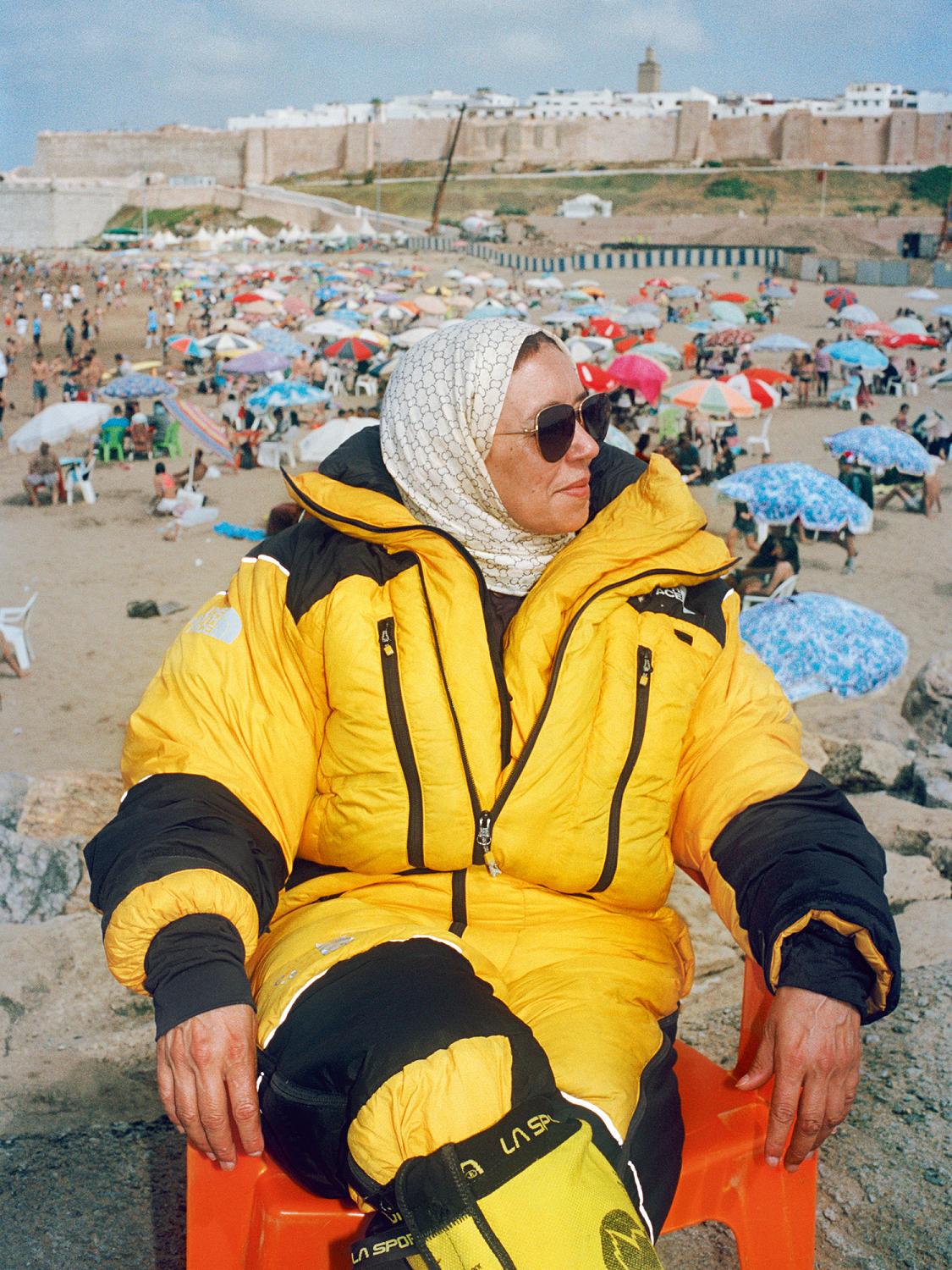
“My life changed a lot after Everest. I know I’m here to do something.”
The day before her visit to Mount Vinson, Bouchra gave a TEDx talk entitled “What did mountains teach me?” in Casablanca. “Tomorrow I will be going to Antarctica to achieve my dream,” she told the audience. Even mediated through YouTube, you can sense the audience’s gripped state, particularly when she recounts her arrival on and departure from Mount Everest’s so-called death zone (which made headlines in 2019 when it claimed the lives of at least 11 people in a single week). There, “oxygen is a third of normal levels and the human body starts deteriorating very fast” (the mountaineer David Breashears has described the sensation of climbing at that altitude as like “running on a treadmill and breathing through a straw”).
Bouchra was on Everest with a local guide, Sherpa Passang, but there was an issue. “We wouldn’t sleep there, as we had to go towards the summit that night. But the wind was so heavy. And another problem arose. My guide’s oxygen device suddenly broke down, so we had to sleep in the fourth camp, at 26,000 feet high.” They shared oxygen through the night. When she awoke, she did a simple two-times-two sum to assess the state of her brain. “When I answered four, I said, ‘Thank God, I can think so far.’”
When we meet, she tells me that they had to spend an extra night at Camp
4 to wait for a new regulator to be delivered from Camp 2. Once that arrived, they began their ascent, at 9.30pm. “The winds were very strong. It was very cold: minus 30°C. It was very difficult.” There were other problems: her lamp stopped working; her glasses, designed to protect her eyes from the freezing temperatures and biting winds, also froze. They passed the bodies of climbers who had fallen foul of the conditions (the protocol, given the virtual impossibility of returning them to base level, being to leave them in situ). Eventually, “we reached the summit at 9am, after climbing for more than 11 hours,” she told me. The expedition had taken one month and 20 days.
“It was an amazing view,” she told her TEDx audience. “From there, I saw the Tibetan plateau and the Khumbu valley. I was above the clouds and the fog... I was above the summits. I felt myself really tiny in front of my God’s creation. I felt very thankful because my God gave me the strength and the ability to get there. And I felt really free.”
In those few places in the world that can be reached by foot yet share an altitude with Boeing 747s, people from North Africa aren’t that common a sight. Nor are there many climbers who wear hijabs or study the Koran in their tents at night. But the communal infrastructure of the world’s great mountains is defined by a kind of statelessness. To see a Moroccan woman may be unusual, but in the end – at least on the mountains – her identity isn’t really relevant. “The mountains belong to nobody, and going there teaches us to have an open mind,” Bouchra tells me. “We don’t feel a sense of people being foreign.”
When it comes to the wider world, she doesn’t deny the symbolism of her achievements, nor that she can show Moroccan and Muslim girls how to keep striving towards the life they want to have. “My life changed a lot after Everest,” she says. “When I came back, I told myself that I’m not here just to go to work, to live a comfortable life. I know I’m here to do something. I must start to change something. So, I quit my job and I started working a lot with girls, with young women. I want to be a role model for them. Because I am Muslim. I wear a hijab. And that has not stopped me.”
Her decision to adopt the hijab as a young woman was a personal one, born out of a piety she had been under no pressure to adopt, neither from family nor from Moroccan society more widely. Indeed, in some universities at that time, it was actively discouraged. In her book she describes the moment of deciding to embrace it as one of understanding who she really was. As far as climbing trips go, she points out that, in effect and appearance, the hijab actually is the kind of headscarf any mountaineer might wear for reasons of warmth and wind protection. “You don’t know that I am wearing a hijab if you see me with other alpinists.” She shows me a picture on her phone in which she is standing with some fellow climbers, looking no different from them.
When I ask Bouchra what the future holds, she lists a host of coming projects. She’s thinking of starting a mountaineering school. She’s preparing another summer school for girls, as she has done for years. It’s a way of giving back, she says, “because I was inspired in summer camp”. And she sometimes takes groups of girls to Toubkal. Does her daughter like climbing? “We’ve done a lot of trekking, me and my husband, with her. I started taking her with me when she was six months old, but now she’s 17 years old and she’s started not to like climbing. She wants to do horse riding.” Bouchra’s book, which was initially published in French and available only in Europe, will finally be published this year in Arabic here in Morocco she hopes.
What she really wants, however, is to be out on an unfamiliar mountain again. “When I came back from Annapurna, I told myself, ‘No, it’s over. I will not climb again.’ But after a few days, I stopped feeling that. I missed something.” She is particularly interested in a group of other legendary and dangerous mountains offered by the Himalayas (all eight-thousanders), such as Cho Oyu, Manaslu, and even K2, which is the second highest in the world and, as of recently, the deadliest.
What is it that keeps drawing her back? Hasn’t she rolled the dice enough? “When I was on the top of Everest or on Annapurna, I didn’t feel joy,” she says. “It wasn’t about being happy or not. But I felt that freedom, that humility, like you are connected with something very big. You are not on Earth. You become yourself in another way. You are not in small things; you’re free from physical things. And maybe that is what I like in the moment. Maybe I want to feel that sensation again.”
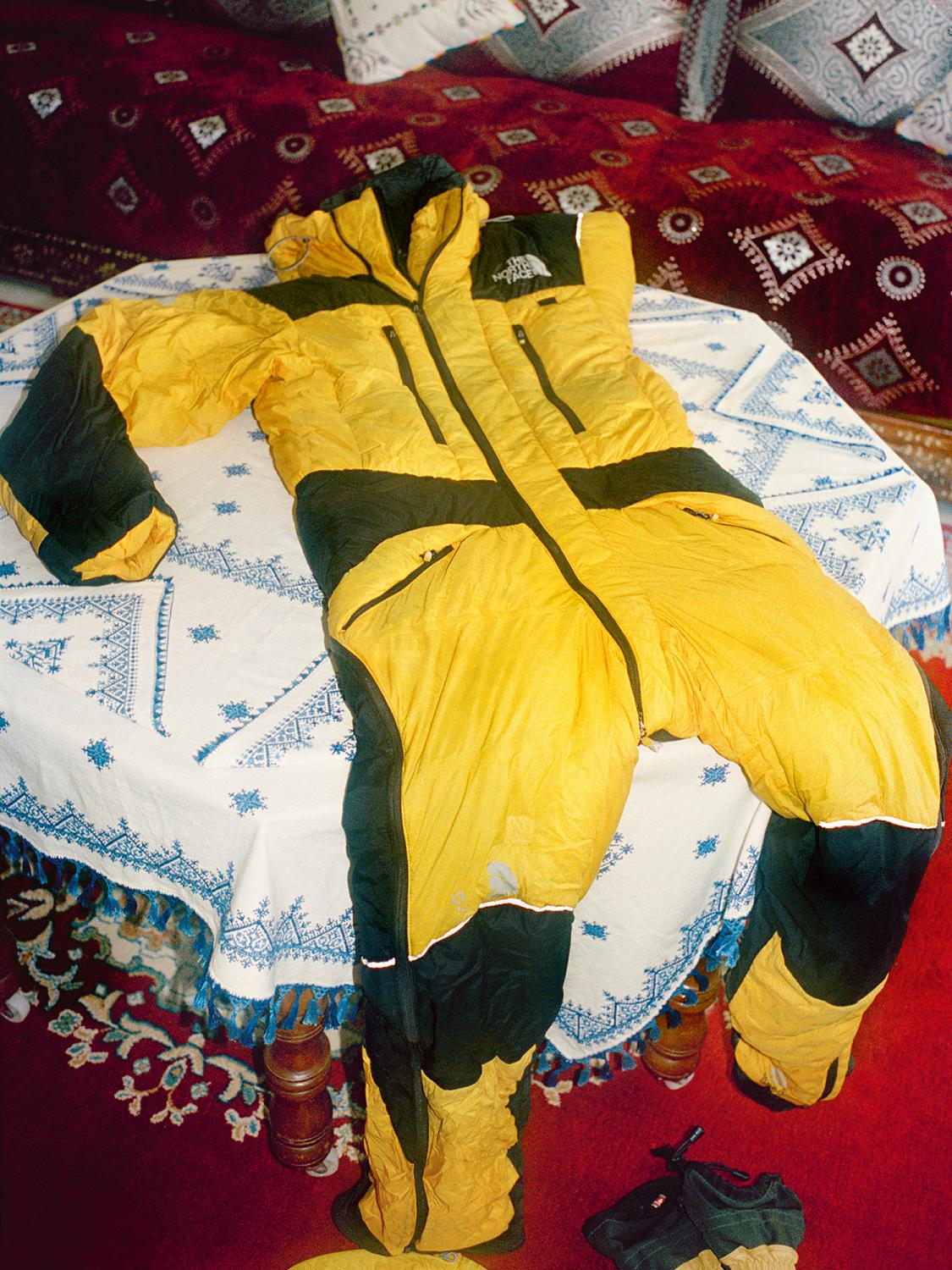
Expeditions such as Bouchra’s seven-week ascent of Everest in 2017 can mean days spent in temperatures of minus 30°C. An all-body down suit is an essential, as are special glasses to protect eyes from freezing over.